



Table of Contents
- Understanding Amazon FBA Fee Structures
- Amazon FBA Prep Service Requirements and Cost Drivers
- How to Optimize FBA Inventory Packaging
- Right-Sizing and Dimensional Weight Strategy
- Third-Party Logistics for Amazon Sellers: In-House vs. 3PL
- Monitoring and Reducing Prep Fees Over Time
- Frequently Asked Questions
Last Updated: September 28, 2026
Understanding Amazon FBA Fee Structures
Amazon FBA fees cover storage, handling, and shipping through Amazon's fulfillment network. The biggest mistake sellers make is ignoring prep costs until they've already committed inventory to the program.
FBA charges include storage fees (based on warehouse duration), fulfillment fees (by size and weight), and prep service fees for labeling, poly bagging, and quality checks.
Reducing Amazon FBA prep fees requires knowing which prep work is optional and which Amazon requires, then planning accordingly.
Amazon FBA Prep Service Requirements and Cost Drivers
Amazon's prep service requirements depend on product type. Many sellers can handle prep work themselves and save significantly.
The main prep services Amazon offers include:
- Labeling and barcode application, Required for all FBA shipments unless you pre-label
- Poly bagging, Required for certain categories like apparel and small items
- Bubble wrapping or box sealing, Required for fragile items or items that need protection
- Quality checks and inspections, Catches damaged or defective items before they reach customers
- Stickering and packaging, Adds your branding or required safety labels
Cost drivers include unit volume, prep complexity, and storage duration. Poly bagging and fragile-item handling increase fees.
Pre-labeling and proper packaging before shipment eliminates Amazon's prep charges, a major savings opportunity.
How to Optimize FBA Inventory Packaging
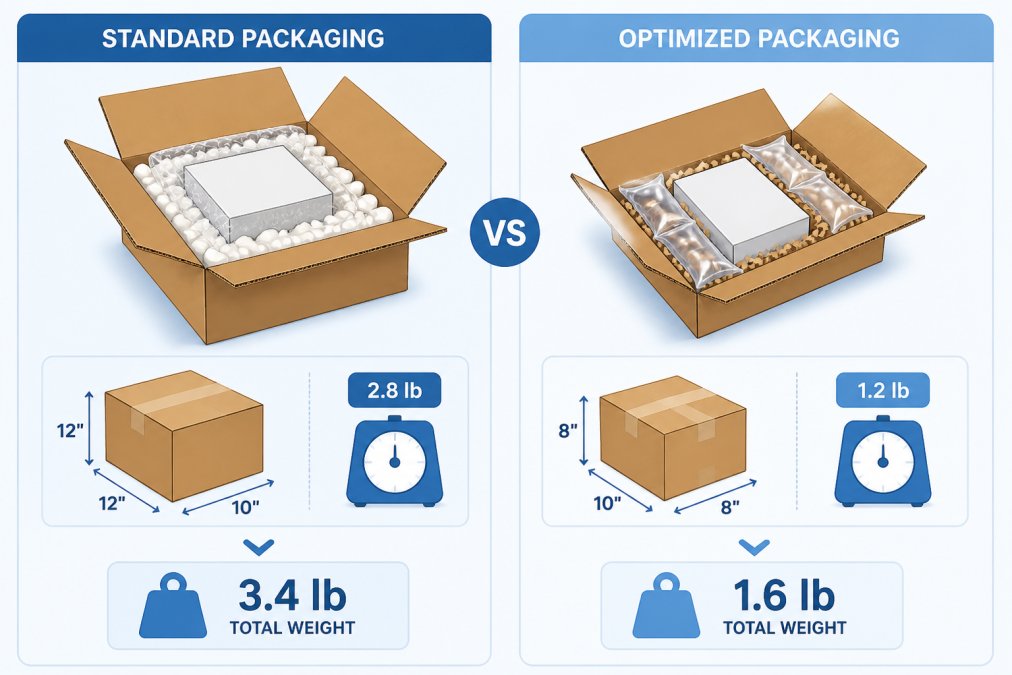
Oversized or inefficient packaging triggers higher dimensional weight charges. Tight packaging and material choice both drive savings.
Packaging size optimization:
Measure your actual product dimensions, not the shipping box. Reducing package size can drop you into a lower size tier.
Measure precisely, remove excess padding, and test packaging with actual shipments to confirm durability.
Dimensional weight = (Length × Width × Height) ÷ 166. If this exceeds actual weight, you pay the higher amount. Compact packaging reduces this charge.
Packaging material selection, the overlooked cost driver:
Material weight compounds across thousands of units and affects both dimensional weight and fulfillment fees.
Corrugated cardboard: Standard boxes weigh 4-6 ounces. Lightweight corrugated saves 0.5-1.5 ounces per box (31-47 pounds annually at 10,000 units). Costs 5-10% more but pays for itself above 2,000 units monthly.
Poly mailers and padded envelopes: Poly mailers weigh 1-2 ounces versus 4-6 ounces for corrugated. For categories requiring poly bagging, use a poly mailer plus lightweight poly bag (2-3 ounces total), 50% lighter than corrugated plus poly bag.
Padded mailers (bubble-lined) add protection without much weight, typically 2-4 ounces. They're ideal for fragile small items that would otherwise require bubble wrap inside a box, which adds bulk and weight.
Void fill materials: Excess void fill adds weight without value. Crinkle paper (0.1-0.3 oz) is lightweight but bulky. Bubble wrap (0.5-1.5 oz) is heavier but more protective. Avoid loose packing peanuts. Kraft paper crinkle (0.05-0.15 oz) and air pillows (0.05-0.2 oz) are ideal for weight reduction.
Example: An 8-ounce product (4" × 3" × 2") with standard packaging (corrugated + bubble wrap + crinkle) weighs 0.91 pounds total. Optimized packaging (lightweight corrugated + air pillows + kraft crinkle) weighs 0.78 pounds. Savings: 0.13 pounds per unit × $0.50-$1.00 per pound = $0.065-$0.13 per unit. At 10,000 units annually: $650-$1,300 in fee savings, minus $50-$100 in material upgrades. Net savings: $550-$1,200 per year.
Reducing weight doesn't sacrifice safety. Amazon requires undamaged arrival, adequate cushioning for fragile items, poly bags for apparel/soft goods/electronics, and no loose packing peanuts. Test packaging with actual shipments before rolling out changes; returns cost far more than material savings.
Work with packaging suppliers who understand dimensional weight. Request samples and compare costs against current materials. For imported products, optimize packaging at the source to save on both ocean freight and Amazon fulfillment.
Right-Sizing and Dimensional Weight Strategy
Dimensional weight pricing is Amazon's way of charging for the space your product occupies, not just its actual weight. Understanding this system is critical to reducing Amazon FBA prep fees.
Products fall into four size tiers: standard-size small, standard-size large, oversize, or special oversize. Standard-size products are significantly cheaper to fulfill.
Standard-size limits: length + girth ≤ 30 inches, longest side ≤ 18 inches, weight < 20 pounds. Exceeding these triggers oversize classification and significantly higher fees.
Audit products against size tier definitions, identify borderline oversize items, and redesign packaging to fit standard-size limits. Prioritize high-volume SKUs; moving one product from oversize to standard-size can save thousands annually.
Third-Party Logistics for Amazon Sellers: In-House vs. 3PL
Choosing between in-house prep, Amazon's prep services, or a third-party logistics provider depends on volume, complexity, and resources. The math must account for labor costs, overhead, and per-unit fees.
In-house prep offers full control but requires labor and space. At 500 units monthly, one part-time employee works. At 5,000 units monthly, you need dedicated staff and infrastructure. A typical operation at 2,000+ units requires one full-time employee ($35,000-$50,000 annually) plus overhead.
Amazon's prep services eliminate your labor but add per-unit costs: $0.40-$0.75 for standard-size items (labeling + poly bagging), $1.00-$2.00 for oversize. These scale with volume and become unsustainable at high volumes.
Third-party logistics providers offer a middle ground: 30-50% lower per-unit costs than Amazon's services, with no in-house overhead.
Break-even analysis: At 500 units/month, in-house is cheapest ($0.05-$0.10/unit). At 2,000 units/month, 3PL becomes competitive ($0.30-$0.80/unit vs. Amazon's $0.50-$1.50). At 5,000+ units/month, 3PL is almost always cheaper due to consolidated scale.
Operational trade-offs:
In-house prep gives you direct control over quality and timing. You can adjust packaging on the fly, inspect every unit, and respond to customer feedback immediately. The downside is inflexibility; if volume spikes, you scramble to hire and train staff. If volume drops, you're stuck with excess labor capacity.
Amazon's prep services offer simplicity but zero visibility into how your products are handled. You can't inspect units before they reach customers. Returns and damage complaints are harder to trace. You also lose negotiating power; Amazon's fees are fixed, and you absorb any increases.
3PL providers offer a balance. Most reputable 3PLs provide real-time inventory visibility through integrations with your inventory management system. You can inspect units before they ship to Amazon.
Decision framework:
-
Calculate your total monthly prep cost under each scenario. Include labor (hourly wage × hours per unit × monthly volume), equipment, space rent, and per-unit service fees.
-
Project 12 months ahead. If you expect volume to grow, factor in the cost of scaling in-house operations (hiring, training, equipment upgrades). 3PL costs scale linearly with volume, so they become more attractive as you grow.
-
Assess your product complexity. Simple products (books, small electronics) are cheaper to prep in-house. Complex products (fragile items, multi-part sets, items requiring custom packaging) are better suited to 3PL because the per-unit cost difference is smaller relative to the value of specialized handling.
-
Evaluate your quality tolerance. If product quality and customer experience are critical to your brand, invest in either in-house prep (where you control quality) or a premium 3PL (where you pay for quality assurance). Amazon's prep services are the riskiest option for quality-sensitive products.
-
Test before committing. If you're considering a 3PL, send a trial shipment of 500-1,000 units. Inspect the results, measure turnaround time, and compare the cost to your current approach. Most 3PLs offer trial pricing.
GTC Logistics handles Amazon FBA preparation at scale. We manage barcode labeling, poly bagging, quality inspections, and shipment coordination. Your inventory stays visible through our Oracle NetSuite integration, so you know exactly what's in our facility and when it ships to Amazon. We also handle CBSA compliance for imported inventory, which is critical if you source products from outside the country.
Monitoring and Reducing Prep Fees Over Time
Reducing Amazon FBA prep fees isn't a one-time project; it's an ongoing process. Fees change, your product mix evolves, and new optimization opportunities emerge.
Track these metrics:
- Average prep fee per unit
- Prep fees as a percentage of revenue
- Storage fees by product and season
- Dimensional weight charges versus actual weight
- Prep service rejections or returns
Frequently Asked Questions
What are the most common causes of high FBA prep fees?
High prep fees typically stem from oversized packaging, improper labeling requiring relabeling, missing barcodes, and insufficient poly bagging. Dimensional weight charges occur when packages are larger than needed for the product. Inventory stored longer than 365 days incurs storage surcharges. Reducing FBA prep fees starts with addressing these specific cost drivers through packaging optimization and accurate upfront preparation.
Is it cheaper to use a third-party logistics provider for FBA prep?
Cost depends on your unit volume, prep complexity, and current FBA fee structure. A 3PL provider handling Amazon FBA prep service requirements may offer lower per-unit costs at scale, especially for high-volume sellers. However, small operations may find in-house prep more economical. Conduct a landed cost analysis comparing your current FBA fees against 3PL pricing, including storage, handling, and integration costs, to determine the break-even point for your business.
How can better packaging reduce my Amazon FBA fees?
Optimizing FBA inventory packaging directly reduces dimensional weight charges and prep labor. Use right-sized boxes that fit your product snugly, eliminating excess void space. Choose lightweight materials like corrugated cardboard instead of heavier alternatives. Remove unnecessary layers of protection and consolidate multiple items into efficient multi-packs. Proper poly bagging and labeling reduce relabeling fees. These packaging improvements lower both the dimensional weight and the prep time Amazon charges for each unit.
How do 2026 Amazon.ca fulfillment fee changes impact my bottom line?
Amazon regularly adjusts fulfillment fees based on size tier, weight, and seasonal demand. Fee increases directly compress profit margins on lower-priced items. Monitor your fee schedule quarterly and adjust pricing, packaging, or SKU strategy accordingly. Right-sizing products and reducing dimensional weight become more critical as fees rise. Track your landed cost including fulfillment fees to ensure profitability. Consider consolidating slow-moving SKUs or shifting high-fee items to alternative fulfillment channels if margins become unsustainable.


