


By GTC Logistics
Getting inventory into an Amazon fulfillment centre should be the easy part of selling on Amazon.ca. Yet labeling mistakes are one of the most common reasons shipments get delayed, units get relabeled at your expense, or listings get pulled. If you sell in Canada, you have two layers of rules to satisfy: Amazon's own FBA labeling standards, and Canadian packaging and labelling law.
This guide walks through both, so your next inbound shipment is received smoothly.
1. Every unit needs a scannable barcode
Amazon requires every item sent to FBA to carry a scannable barcode. That barcode is how the fulfillment network identifies your product and ties it to your account. Which barcode you use depends on your settings and your product's eligibility.
Manufacturer barcode (UPC, EAN, ISBN). If your product is eligible and you choose manufacturer barcode tracking, Amazon can scan the barcode already on your packaging. The catch: your units may be pooled with identical units from other sellers, which is a risk if you have a private label product or want to protect your inventory from counterfeit or lower-quality stock.
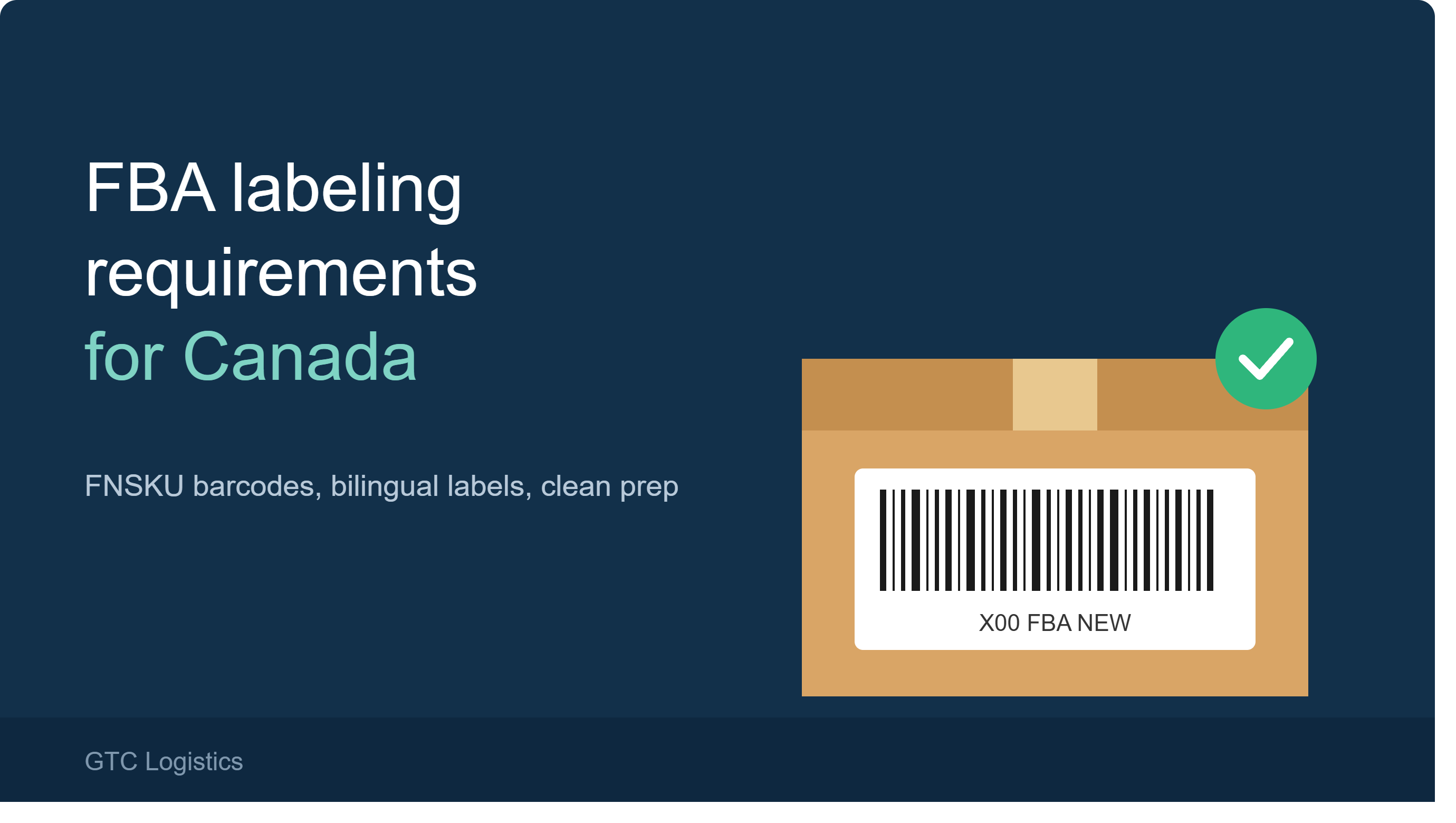
Amazon barcode (FNSKU). The FNSKU is a unique code Amazon generates when you add a product and choose the Amazon barcode option. It keeps your stock identified as yours. Most private label sellers use FNSKU labels for this reason.
If your product doesn't qualify for manufacturer barcode tracking, or you don't have a barcode, an FNSKU label is required.
A note on changing rules: Amazon updates its barcode and prep policies regularly, and some recent changes have applied to sellers outside Brand Registry in certain marketplaces. Always confirm the current requirement for your account in the shipment creation workflow in Seller Central before you print anything.
2. What a good FNSKU label looks like
A correct FNSKU label carries the FNSKU or unit barcode, the product title, and the item's condition. Beyond content, the label itself has to work in a fast-moving warehouse:
- Print in black on a white background so scanners can read it reliably.
- Use a clean, high-resolution print. Smudged, faded or stretched barcodes are a leading cause of receiving problems.
- Apply it to a flat area, not over a seam, fold or curved edge.
- Leave a small margin around the label so it doesn't run onto an edge or corner.
- Cover or remove any old or conflicting barcodes. A second scannable code can confuse the system and delay check-in.
- Make sure the label is correct for the right product and condition. Using the wrong FNSKU is a frequent and costly mistake.
If you print the FNSKU directly onto your packaging instead of using a sticker, it must still meet the same size and scannability standards.
3. Who applies the labels?
You have three options:
- Label units yourself. Cost-effective for small volumes, but time-consuming and error-prone at scale.
- Use Amazon's labeling service. Amazon applies labels for a per-unit fee, which can add up quickly.
- Use a prep and logistics partner. A third party can receive your goods, apply compliant labels, bag and prep them, and ship them to Amazon, often more cheaply and with fewer errors than the alternatives.
If Amazon has to fix labeling problems on arrival, expect per-unit relabeling charges and slower check-in.
4. Poly bags and suffocation warnings
Poly bags with an opening of 5 inches or more need a suffocation warning that stays visible and legible after the bag is sealed. Minimum font size depends on bag dimensions, so check Amazon's current packaging and prep guidance for your bag size. Make sure your FNSKU label is also scannable through the bag without wrinkles or glare.
5. Canadian requirements: bilingual and compliant
This is where many sellers coming from the U.S. get caught. Amazon expects products sold on Amazon.ca to meet applicable Canadian packaging and labelling regulations. For most prepackaged consumer goods that means:
- English and French. Required information must appear in both official languages. Bilingual labeling gaps are a common cause of listing removals on Amazon.ca, even for products that are perfectly compliant in the United States.
- Core mandatory information. Under the Consumer Packaging and Labelling Act, prepackaged products generally must show the product's identity, its net quantity, and the name and principal place of business of the dealer.
- Metric measurements. Net quantity must be shown in metric units.
- Product-specific rules. Textiles, toys and children's products, cosmetics, food, and other categories have their own additional labelling requirements, often with specific bilingual wording.
Bilingual text should be easy to read and presented side by side or close together. Some limited exemptions exist, so if you are unsure whether your product qualifies, check the Government of Canada's guidance or consult a compliance specialist.
One practical point: your FNSKU label should never cover mandatory Canadian label information (or an ISBN on a book, for example). Place it where it leaves required content visible.
6. The most common labeling mistakes
- Shipping without the correct barcode setting selected, so the label doesn't match what Amazon expects
- Leaving old barcodes uncovered
- Printing low-quality or smudged labels
- Putting the label over a seam, fold or curve
- Using English-only packaging for Amazon.ca
- Covering required Canadian label content with the FNSKU sticker
- Mixing up FNSKUs between similar variations or conditions
7. A quick pre-shipment checklist
- Confirm your barcode setting (manufacturer or Amazon barcode) for each SKU.
- Print FNSKU labels in black on white, at a scannable quality.
- Remove or cover all other barcodes.
- Apply labels to a flat surface, clear of seams and mandatory text.
- Add suffocation warnings to qualifying poly bags.
- Verify bilingual English and French packaging content and metric net quantity.
- Scan a sample of labeled units before you box up the shipment.
Let GTC Logistics take labeling off your plate
Labeling is detail-heavy work, and small errors compound across hundreds or thousands of units. At GTC Logistics, we help Canadian Amazon sellers get inventory prepped and shipped right the first time. Get in touch to talk about your next FBA shipment.
This article is general information and not legal or compliance advice. Amazon's requirements change, so always confirm current rules in Seller Central and, for regulated product categories, with the relevant Canadian authorities.