



Table of Contents
- E-commerce Fulfillment Models: In-House, Third-Party, and Hybrid Approaches
- Building Your E-commerce Fulfillment Checklist
- Third-Party Logistics Provider Selection: What to Evaluate
- Pick and Pack Fulfillment: Execution and Error Reduction
- E-commerce Fulfillment Metrics That Drive Results
- Inventory Management and Real-Time Visibility
- Building Resilience and Scaling for 2026
- Frequently Asked Questions
Last Updated: October 16, 2026
E-commerce Fulfillment Models: In-House, Third-Party, and Hybrid Approaches
E-commerce fulfillment covers receiving inventory, processing orders, picking and packing, and shipping to customers. How you structure it determines your speed, costs, and customer satisfaction. At GTC Logistics, we help businesses choose the model that matches their growth stage and capacity.
Three primary approaches exist, each with distinct trade-offs. Your choice depends on order volume, growth trajectory, inventory complexity, and desired operational control.
In-House Fulfillment: Control and Complexity
In-house fulfillment means you own the warehouse space, manage staff, and handle all picking and packing yourself, giving you complete order visibility and control over quality standards.
The upside is control: you set processes, train staff to your standards, and respond instantly to change.
The downside is scale. As volume grows, you need more space, staff, and management overhead, and peak season becomes a staffing crisis.
Third-Party Logistics: Speed and Scalability
Third-party logistics (3PL) providers handle fulfillment for you: you send inventory, they receive, pick, pack, and arrange shipping.
The advantage is flexibility: if you ship 100 orders one month and 10,000 the next, costs scale proportionally and you avoid capital investment in facility expansion.
The trade-off is control and cost per unit.
Hybrid Models: Flexibility and Cost Balance
A hybrid approach uses both in-house and 3PL services: handle fast-moving products in-house to maximize margin while the 3PL manages slower-moving inventory and peak-season overflow.
This requires coordination and visibility across both operations. If your in-house and 3PL systems don't talk to each other, you risk overselling or leaving orders unfulfilled.
Building Your E-commerce Fulfillment Checklist
A fulfillment checklist ensures you've addressed operational and compliance requirements before launch and during ongoing operations. Missing one item can cascade into costly errors.
Pre-Launch Readiness
Before you accept your first order, confirm these elements are in place.
Inventory system integration: Your e-commerce platform (Shopify, WooCommerce, custom build) must connect to your fulfillment operation.
Returns process: Define how customers initiate returns, where returned items go, and how you'll process them.
Quality control standards: Document what "correct" looks like: packing method, materials, and accuracy verification before shipping.
Ongoing Operations and Peak Season Prep
Once live, continuous improvement and seasonal preparation keep fulfillment running smoothly.
Monitor order cycle time, the elapsed time from order placement to shipment, weekly. If it trends upward, you're approaching capacity.
Review picking accuracy monthly. A 1% error rate means 1 in 100 orders is wrong, or 10 unhappy customers per 1,000 orders.
Third-Party Logistics Provider Selection: What to Evaluate
Choosing a 3PL is one of your most important operational decisions. The wrong partner creates bottlenecks, errors, and dissatisfaction; the right one scales with you and becomes an extension of your team.
Compliance and Security Standards
If you're importing products, your 3PL must understand customs compliance. In Canada, CBSA (Canada Border Services Agency) bonded warehousing is required for many import workflows, letting you store imported goods without paying duties until release for sale and reducing working capital needs (Memorandum D7-4-4: Customs Bonded Warehouses).
Ask about security protocols: theft prevention, recall handling, and insurance for inventory in their care. Request references from clients in your industry and ask about accuracy rates, responsiveness, and problem handling.
For e-commerce brands preparing inventory for Amazon FBA, confirm the 3PL understands Amazon's labeling, packaging, and documentation requirements. Amazon is strict; an unfamiliar 3PL causes shipment rejections and delays.
Technology Integration and Visibility
Your 3PL's technology stack determines how well you manage fulfillment remotely. At minimum, you need real-time visibility into inventory levels and order status.
Ask about API capabilities and support for your e-commerce platform. If integration requires custom development, understand who pays and how long it takes. A 3PL that integrates seamlessly saves time and reduces friction; one requiring manual uploads or middleware adds complexity.
Pick and Pack Fulfillment: Execution and Error Reduction
Picking and packing are where fulfillment happens, and every error here reaches your customer. Speed and accuracy are both critical and often in tension.
Warehouse Layout and Process Optimization
Warehouse layout directly affects picking speed and accuracy.
A well-designed layout reduces picker travel. If your fastest-moving 20% of products are scattered, pickers waste time walking; consolidate them in a central, easy-access area.
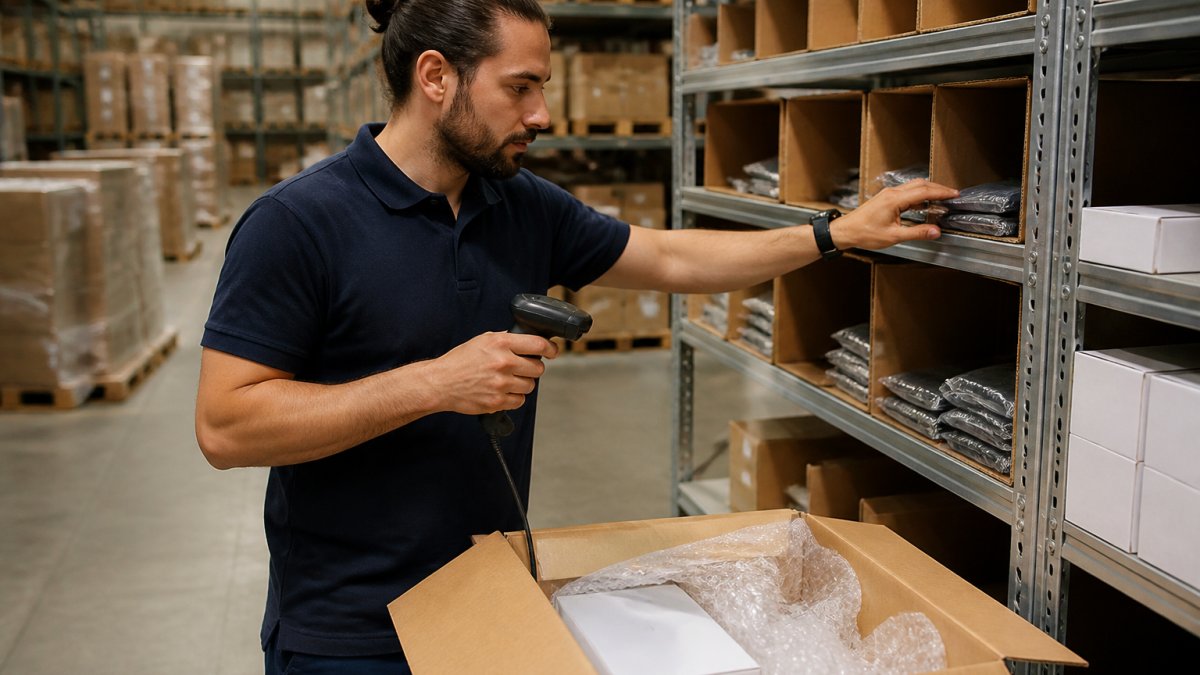
Implement a picking system: paper lists, barcode scanning, or voice-directed picking (which tells the picker what to grab next).
Quality Control and Accuracy Standards
Before shipping, verify each order is correct, a step called "pack verification" or "quality control." The simplest version has the packer scan each item as it goes into the box while the system confirms completeness; more rigorous approaches add a second person checking the packed box against the order before sealing.
Pick accuracy directly affects customer satisfaction and returns costs. A 99% accuracy rate means 1% of orders are wrong, or 50 errors at 5,000 orders per month, each triggering a return, refund, and dissatisfied customer. Invest in processes and tools that push accuracy above 99.5%.
E-commerce Fulfillment Metrics That Drive Results
Measuring the right metrics shows whether fulfillment is performing well and where to improve. Without data, you're guessing.
Order Cycle Time and Shipping Speed
Order cycle time is the elapsed time from order placement to shipment from your facility. It differs from delivery time (which depends on the carrier) but matters equally to customer satisfaction.
Typical e-commerce order cycle time is 1-2 days in-house and 1-3 days for 3PL (depending on shipment processing frequency).
Track this metric weekly. If it's trending upward, you're approaching capacity.
Cost Per Order and Fulfillment Economics
Cost per order is total fulfillment cost divided by orders shipped, including labor, warehouse space, packaging, carrier fees, and technology. It matters because it directly affects profit margin.
In-house, calculate it as (monthly labor + rent + packaging + shipping) / orders shipped.
As volume grows, in-house cost per order typically decreases (you're spreading fixed costs across more orders). 3PL cost per order may decrease slightly due to volume discounts, but it's largely linear.
Inventory Management and Real-Time Visibility
Inventory visibility is the foundation of accurate fulfillment. If you don't know what you have, you can't fulfill orders reliably.
Demand Forecasting and Stock Placement
Demand forecasting predicts future order volume so you can stock appropriately.
For seasonal businesses, historical data is your best tool. If you sold 500 units last December, plan for similar volume this December (adjusting for growth).
Stock placement decides where inventory is held: your warehouse, a 3PL facility, or split across locations.
Returns Management and Reverse Logistics
Returns are inevitable in e-commerce. How you handle them determines whether a dissatisfied customer becomes a repeat buyer or leaves a negative review.
Establish a clear returns policy: the return window, whether returns are free or paid, and refund speed.
Once returned items arrive, inspect them, determine resale eligibility, and restock or dispose of them.
Building Resilience and Scaling for 2026
The fulfillment landscape is shifting. Supply chain disruptions, labor challenges, and rising expectations for speed and sustainability are forcing businesses to rethink how they fulfill orders.
Automation and AI Governance
Automation, robotic picking, conveyor systems, automated sorting, increases picking speed and accuracy.
But automation requires significant capital investment and suits standardized products.
AI is increasingly used for demand forecasting, inventory optimization, and picking optimization (determining the most efficient pick order).
Governance matters. As you adopt automation and AI, establish clear decision rights: who approves significant picking process changes, how you handle automation errors, and how you maintain human oversight over critical decisions.
Omnichannel Fulfillment and Distributed Networks
Omnichannel fulfillment means fulfilling orders from multiple sales channels, your website, Amazon, social media, retail stores, from the same inventory pool.
Distributed fulfillment networks use multiple fulfillment centers (regional hubs or micro-fulfillment centers) to cut shipping distance and time.
For mid-market e-commerce brands, a distributed network is often overkill; a single well-located fulfillment center positioned to serve your customer base is usually sufficient.
Building a fulfillment operation that scales requires the right model, strong processes, and measuring what matters. Whether you need CBSA bonded warehousing for imported inventory, Amazon FBA preparation, or full-service order fulfillment powered by Oracle NetSuite integration, we provide the infrastructure and expertise to scale without the complexity.
Frequently Asked Questions
What are the main steps in the e-commerce fulfillment process?
The core e-commerce fulfillment process includes receiving inventory, storing stock, picking items from shelves, packing orders accurately, and shipping to customers. Order processing begins the moment a customer places an order, triggering picking and packing workflows. Quality checks and address verification happen before shipment. Real-time inventory tracking ensures stock visibility throughout each step. Returns are processed separately through reverse logistics channels. Efficiency at each stage reduces order cycle time and improves customer satisfaction.
How do you choose a third-party logistics provider?
Evaluate providers on compliance standards, technology integration capabilities, and geographic coverage that matches your customer base. Review their warehouse management systems and whether they integrate with your e-commerce platform. Assess their experience with your specific product types and order volumes. Check references from similar-sized businesses. Understand their service levels, shipping options, and how they handle peak season demand. Verify they can provide real-time inventory visibility and detailed reporting on fulfillment metrics like order accuracy and on-time delivery rates.
What should an e-commerce fulfillment checklist include?
A comprehensive e-commerce fulfillment checklist covers inventory receiving and verification, warehouse organization and labeling systems, picking accuracy procedures, packing standards and material selection, carrier selection and rate optimization, order tracking setup, returns processing workflows, and peak season capacity planning. Include compliance requirements if handling bonded or cross-border inventory. Document quality control checkpoints, customer communication protocols, and contingency plans for supply disruptions. Establish metrics for monitoring pick accuracy, order cycle time, and cost per order. Review the checklist quarterly and update it based on fulfillment performance data.
Which fulfillment metrics should an e-commerce business track?
Track order accuracy (percentage of orders shipped without errors), order cycle time (time from order placement to shipment), on-time delivery rate, and cost per order. Monitor inventory turnover and stock-out frequency to assess demand forecasting accuracy. Measure fulfillment cost as a percentage of order value. Calculate shipping cost per unit and compare across carriers. Track returns rate and reverse logistics costs. Monitor warehouse utilization and labor productivity. These e-commerce fulfillment metrics reveal operational efficiency, identify cost reduction opportunities, and highlight areas affecting customer satisfaction.
How can businesses reduce order fulfillment errors?
Implement barcode scanning at every stage: receiving, put-away, picking, and packing. Design warehouse layouts to minimize picking distance and reduce confusion between similar SKUs. Use pick-to-light or voice-guided picking systems to reduce manual errors. Conduct secondary verification before packing and use address validation software. Train staff on accuracy standards and create accountability through performance tracking. Automate order routing to ensure correct carrier and service level selection. Review error logs weekly to identify patterns and adjust processes accordingly. Regular quality audits catch mistakes before shipment.
When should an e-commerce business outsource fulfillment to a third-party provider?
Consider outsourcing when order volume exceeds 500 orders per month, when you lack warehouse space or capital for infrastructure, or when managing fulfillment diverts focus from core business activities. Outsourcing makes sense if you operate across multiple sales channels and need distributed fulfillment. It's beneficial if you require specialized services like Amazon FBA preparation, bonded warehousing for imports, or cross-border compliance. Evaluate the cost per order from a provider against your internal fulfillment costs, including labor, rent, and equipment. Outsourcing also provides scalability for seasonal peaks without fixed overhead.
What is the difference between pick and pack fulfillment and other fulfillment models?
Pick and pack fulfillment refers to the specific warehouse operations where staff retrieve individual items from inventory (picking) and place them into customer orders (packing). This is the core operational component within any fulfillment model. It differs from fulfillment models like in-house versus third-party, which describe who performs the work. Pick and pack efficiency directly impacts order accuracy, cycle time, and fulfillment costs. Optimizing pick and pack processes through layout design, barcode scanning, and quality controls reduces errors and accelerates shipping, making it a critical focus area regardless of whether fulfillment is handled internally or outsourced.
How does real-time inventory visibility improve e-commerce fulfillment?
Real-time inventory visibility prevents overselling, reduces stockouts, and enables accurate order promises to customers. When warehouse management systems sync with your e-commerce platform, inventory updates instantly as orders are placed and fulfilled. This allows demand forecasting algorithms to work with accurate data, improving stock placement decisions. During peak seasons, visibility helps identify bottlenecks and reallocate resources. It enables faster exception handling when inventory discrepancies occur. Customers receive accurate delivery estimates based on actual stock levels. For businesses using distributed fulfillment networks, real-time visibility ensures orders route to the nearest warehouse with stock, reducing shipping time and costs.


