



Table of Contents
- ShipBob vs 18 Wheels Logistics: Head-to-Head Overview
- Service Scope and Warehouse Locations
- Order Fulfillment and Pick-and-Pack Operations
- Technology, Integrations, and Inventory Management
- ShipBob Alternatives for Canadian Brands
- Choosing the Right E-Commerce Fulfillment Provider
- Frequently Asked Questions
Last Updated: October 20, 2026
ShipBob vs 18 Wheels Logistics: Head-to-Head Overview
When you're scaling an e-commerce operation or managing international inventory, shipbob vs 18 wheels logistics matters because your fulfillment partner directly impacts delivery speed, cost, and customer satisfaction. Both platforms serve Canadian brands, but they approach warehousing, inventory management, and order fulfillment differently.
At GTC Logistics, we've worked with brands evaluating these providers and understand the core tension: you need a partner that handles complexity without hidden fees, maintains inventory accuracy, and integrates seamlessly with your existing systems. This guide breaks down how these two services differ across the categories that actually drive your decision, warehouse locations, technology capabilities, service scope, and real-world fit for different business sizes.
The shipbob vs 18wheels logistics decision ultimately depends on your order volume, geographic needs, and tolerance for platform learning curves. We'll walk through what each brings to the table, where they fall short, and how to assess which fits your operation.
Service Scope and Warehouse Locations
A fulfillment provider's service scope determines what you can hand off and what stays on your plate. The two providers sit at different points on that spectrum, and the gap widens once you map services to Canadian shipping realities.
ShipBob's model is built around a distributed fulfillment network: inventory is split across multiple warehouses so orders route to the facility closest to the end customer. The core scope covers receiving, storage, pick-and-pack, and carrier selection, with the network doing the geographic work. For a brand selling across multiple provinces and into the United States, that distribution shortens ground zones and can pull delivery windows down from a week to a few days. The trade-off is that distributed inventory multiplies your SKU counts per location, which raises storage exposure and complicates replenishment planning.
18 Wheels Logistics' model is anchored in regional warehousing plus heavy freight capability. Its scope extends beyond parcel fulfillment into container destuffing, cross-docking, and specialized handling for imported goods, with cross-docking windows that run into the evening. That matters if your inbound flow is container-based and you need freight and parcel operations under one roof rather than stitching together a drayage provider, a transload facility, and a parcel 3PL.
For Canadian brands, the geographic question is not "how many warehouses" but "where is my demand density." A single regional warehouse in the right corridor can beat a distributed network when your customers cluster in one or two provinces, because you avoid split inventory and internal transfer costs. Once demand spreads coast to coast and into cross-border zones, network density starts to pay for itself in zone skips.
| Decision factor | Distributed-network model | Regional freight-plus-fulfillment model |
|---|---|---|
| Best fit | Multi-province and cross-border parcel volume | Container imports, bonded storage, freight-heavy flows |
| Inventory posture | Split across nodes; more SKUs per site | Concentrated; simpler counts, longer outbound zones |
| Inbound handling | Parcel and LTL receiving | Container destuffing, cross-docking, specialized handling |
| Main cost driver | Storage per node plus transfer and zone costs | Receiving labor plus outbound distance to customer |
GTC Logistics operates from a 30,000 square foot facility with CBSA bonded warehousing, combining bonded import storage with order fulfillment in one location.
Order Fulfillment and Pick-and-Pack Operations
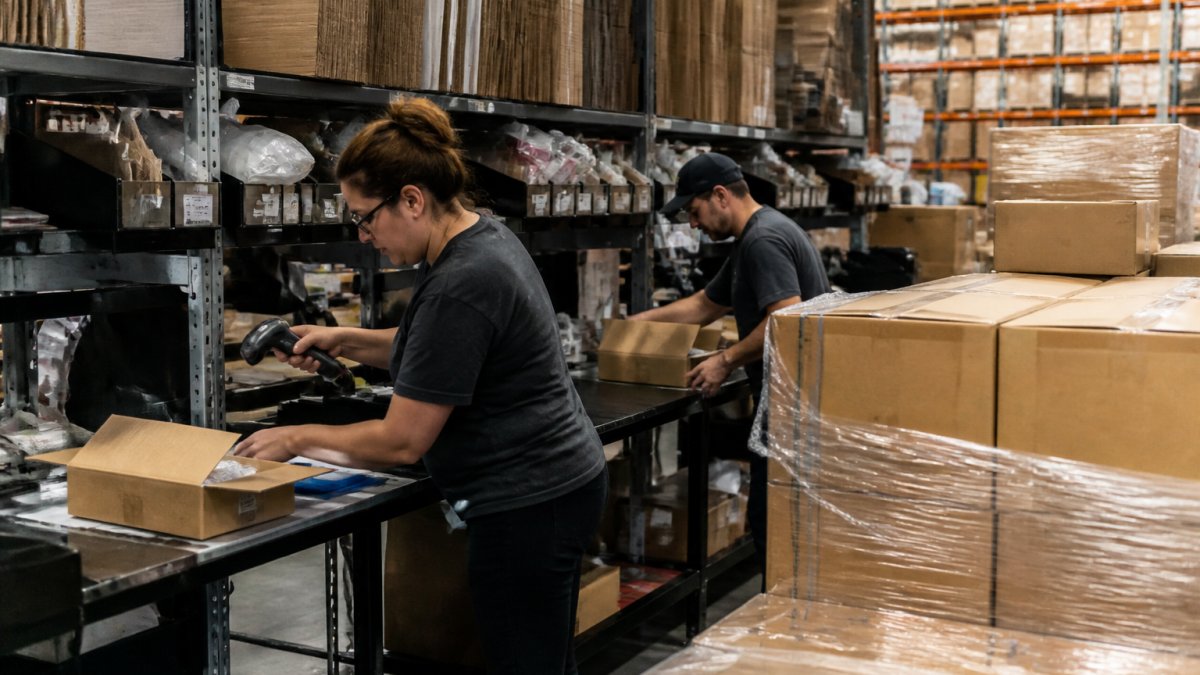
Pick-and-pack speed and accuracy define the fulfillment experience. ShipBob's model emphasizes automation and high-volume throughput, which works well for brands shipping hundreds of orders daily. Their systems are built for scale and speed, with pick-and-pack fees structured around volume commitments.
18 Wheels Logistics handles pick-and-pack with a more hands-on approach, particularly useful if your orders require custom packaging, kitting, or special handling. Their cross-docking services run until 9:00 PM, which accommodates brands with flexible shipping windows or last-minute inventory movements.
The real difference emerges when you examine order accuracy and returns processing. High-volume providers sometimes trade precision for speed. If your business model depends on near-zero error rates, whether because you're selling high-value items or managing tight margins, you need a partner that prioritizes accuracy over pure throughput.
GTC Logistics integrates with Oracle NetSuite through the Inventory Cloud platform, giving you real-time visibility into every pick, pack, and shipment. This transparency matters when you're trying to diagnose fulfillment issues or audit your operation.
Technology, Integrations, and Inventory Management
Your fulfillment platform lives inside your tech stack. ShipBob offers broad e-commerce integrations, Shopify, WooCommerce, Amazon, with API access for custom connections. Their dashboard provides order visibility and basic reporting.
18 Wheels Logistics supports standard integrations but leans toward traditional warehouse management systems. If you're running Shopify or another mainstream platform, integration is straightforward. If you're using NetSuite, Epicor, or another enterprise system, you'll need to verify compatibility.
The distinction matters most when scaling. A platform that integrates cleanly with your inventory system eliminates manual data entry, reduces errors, and gives you the real-time visibility required to make fast decisions. Clunky integrations create bottlenecks, you end up with inventory counts that don't match reality, orders that slip through cracks, and customer service headaches.
According to Gartner's 2026 supply chain research, real-time inventory visibility reduces fulfillment errors by an average of 18% and cuts excess inventory holding by 12%. That's not trivial when you're managing thousands of SKUs across multiple locations.
GTC Logistics uses Oracle NetSuite's Inventory Cloud, which means you get instant access to inventory data, automated reorder triggers, and seamless sync with your accounting system. If you're already on NetSuite, this eliminates integration friction entirely.
ShipBob Alternatives for Canadian Brands
Most "alternatives" lists swap one logo for another without telling you what changes in practice. A more useful frame is business-fit mapping: match your order profile to the operating model, then compare total cost like-for-like.
By order profile:
- Low-volume startup (under roughly 50 orders a day): a distributed network's per-node minimums and split inventory usually cost more than they save. A single regional warehouse with no node minimums keeps storage and receiving predictable while you find product-market fit.
- High-SKU catalog: split inventory across many nodes multiplies SKU counts and slows replenishment. A concentrated warehouse with strong inventory accuracy and real-time visibility usually wins until volume justifies distribution.
- Bulky or oversize goods: parcel networks price oversize handling punitively. A freight-capable provider that already handles pallets and containers can absorb bulky SKUs without per-piece surcharges stacking up.
- Cross-border expansion: the decision hinges on customs mechanics, not warehouse count. Bonded storage, duty deferral, and a single handoff point reduce the risk of inventory sitting in customs while orders wait.
Like-for-like total cost. Compare quotes on the same six lines: receiving (per unit or per hour), storage (per pallet or per cubic foot per month), pick-and-pack (per order plus per additional item), packaging materials, postage, and minimums or surcharges. A provider with a lower pick fee but a monthly minimum and a receiving surcharge can cost more at low volume than a higher per-pick rate with no floor. Ask each provider to price the same 30-day order history and the same inbound shipment; the gap between headline rates and landed cost usually shows up in receiving and minimums, not pick fees.
Service-level commitments. Request documented cut-off times, receiving turnaround, order accuracy targets, and dispatch speed, plus the remedy if a service level is missed. Broad alternatives pages rarely publish these, which is exactly where a regional provider can differentiate with written commitments.
Implementation and migration. Onboarding timelines, inventory transfer method, integration setup, and contract terms with exit costs belong in the comparison. A provider that can migrate inventory in days without a system rebuild removes a hidden switching cost that never appears on a rate card.
For Canadian brands importing inventory or selling across provinces, a regional partner often delivers better economics than a US-focused network: no cross-border shipping premiums on domestic orders, faster domestic delivery, and a team fluent in Canadian customs requirements. The honest trade-off is network reach versus hands-on flexibility, and the right answer depends on which one your current bottleneck actually is.
Choosing the Right E-Commerce Fulfillment Provider
The decision framework comes down to five factors: order volume, geographic scope, integration requirements, complexity of your inventory, and your tolerance for learning new systems.
If you're shipping 50+ orders daily with simple fulfillment needs and want national coverage, a distributed network like ShipBob makes sense. You get speed, automation, and hands-off management.
If you're importing containers, managing bonded inventory, or shipping to multiple countries, a provider with customs expertise and flexible warehousing becomes essential. This is where regional specialists excel.
If you're on NetSuite or another enterprise system, integration simplicity should weigh heavily in your decision. A platform that syncs cleanly with your existing stack eliminates months of implementation headache and ongoing manual work.
The honest assessment: there's no universal best choice. ShipBob works brilliantly for high-volume e-commerce brands with straightforward fulfillment. 18 Wheels Logistics suits brands with complex logistics needs and regional focus. GTC Logistics offers rapid fulfillment and sophisticated inventory management for Canadian brands, particularly if you're importing or managing CBSA compliance.
Start by mapping your actual requirements, not what you think you'll need in three years, but what you need today. Then test each provider's capabilities against that map. The right choice is the one that solves your current bottleneck without forcing you to adopt unnecessary complexity.
Choosing between fulfillment partners shouldn't mean sacrificing either speed or accuracy. GTC Logistics delivers both through Oracle NetSuite integration, CBSA bonded warehousing, and direct access to real-time inventory data. Whether you're managing Amazon FBA preparation, cross-border imports, or rapid domestic fulfillment, our 30,000 square foot facility and expert team handle the complexity so you can focus on growth. RATE REQUEST to discuss your specific fulfillment needs and see how we can simplify your supply chain.
Frequently Asked Questions
What are the main differences between ShipBob and 18 Wheels Logistics?
ShipBob operates as a distributed 3PL with multiple fulfillment centers across North America, focusing on speed and e-commerce integration. 18 Wheels Logistics emphasizes warehousing and trucking services with a regional presence. The choice depends on whether you prioritize fast order processing and API integrations (ShipBob) or comprehensive warehousing and transportation solutions (18 Wheels). Each provider's strength aligns with different business models and growth stages.
Which e-commerce fulfillment provider is better for cross-border shipping from Canada?
Both providers offer cross-border capabilities, but their approaches differ. ShipBob has established U.S. fulfillment centers for faster cross-border delivery, while 18 Wheels Logistics brings regional trucking expertise and warehouse infrastructure. For businesses requiring CBSA bonded warehousing and customs compliance during import, a provider with local bonded warehouse services may offer stronger end-to-end support. Evaluate based on your import frequency, inventory volume, and customs documentation needs.
What should I compare when evaluating 3PL providers?
Focus on warehouse locations relative to your customer base, pick-and-pack accuracy rates, shipping speed commitments, technology integrations with your e-commerce platform, inventory management visibility, and total cost of fulfillment. Also assess customer support responsiveness, scalability during peak seasons, and any specialized services you need (bonded warehousing, cross-docking, ocean freight coordination). Request references from businesses similar to yours and clarify all fees upfront.
Can I switch from ShipBob to another 3PL without major disruption?
Switching providers requires careful planning. Coordinate inventory transfers, update shipping integrations, test order processing workflows, and communicate changes to customers. Most modern 3PLs support API connections to major e-commerce platforms, reducing technical friction. Plan the transition during a slower sales period if possible. Clarify contract terms with your current provider regarding early termination or inventory handling fees before committing to a move.


