


Quick Summary
Scaling e-commerce logistics means moving through stages, from in-house packing to a 3PL or hybrid model, once order volume and peak demand outgrow your current setup. Choose the model by measuring your orders per day, SKU count, fully loaded cost per order, and accuracy before switching.
- Watch for missed cutoffs, rising shipping errors, and founders packing boxes as signs of outgrowing in-house shipping.
- Match your fulfillment model to your growth stage rather than jumping ahead to large contracts.
- Compare 3PL providers using your own order profile, including average units, peak volume and returns rate.
- Keep one shared inventory record across all sales channels to prevent overselling.
- Track order accuracy, pick time and on-time dispatch rate as early indicators of bottlenecks.
Table of Contents
- Why Logistics Becomes the Bottleneck as E-Commerce Orders Grow
- Signs Your E-Commerce Business Has Outgrown In-House Shipping
- A Staged Logistics Roadmap for Each Growth Phase
- Choosing Between In-House, Third-Party Logistics and Hybrid Fulfillment
- The E-Commerce Order Fulfillment Process, Step by Step
- Inventory Management for E-Commerce Across Channels
- Scaling Logistics Next Steps: Requesting a Rate Quote from GTC Logistics
- Frequently Asked Questions
Which Logistics Strategies Scale E-Commerce Growth?
Last Updated: November 2, 2026
Why Logistics Becomes the Bottleneck as E-Commerce Orders Grow
Logistics is rarely the first thing an e-commerce founder worries about. Product, marketing and sourcing take the early attention.
E-commerce logistics is the set of operations that move inventory from supplier to storage to customer, including receiving, storage, order picking, packing and last-mile delivery.
The real problem is rarely one bad step. It is that growth stresses every step at once.
Signs Your E-Commerce Business Has Outgrown In-House Shipping
Most brands wait too long to change how they ship. Operational signals are often the clearest. If your team regularly misses same-day cutoffs, ships the wrong item more than occasionally, or spends more hours on packing than on selling, the in-house setup may be costing you more than it appears.
Watch for these specific warning signs:
- Order accuracy slips during peak periods, and returns start climbing
- Shipping cutoffs are missed because packing takes longer than planned
- Inventory counts disagree with what the system shows
A common mistake is treating these as staffing problems and hiring more people. Adding labour to a process that has outgrown its layout rarely fixes the underlying constraint.
A Staged Logistics Roadmap for Each Growth Phase
Logistics needs change as a business moves through distinct stages, and the right model at one stage can become a drag at the next. A practical roadmap looks like this:
- Early stage (low volume, few SKUs): Keep fulfillment in-house or use a simple shipping tool. The priority is learning your demand pattern without fixed warehouse costs.
- Growth stage (steady volume, rising returns): Begin separating storage from packing. Introduce inventory counting discipline and a clear returns process before the volume forces it on you.
- Scale stage (multiple channels, seasonal peaks): Move toward a 3PL or hybrid model so peak capacity is available without carrying permanent overhead.
- Mature stage (international sourcing, complex compliance): Add customs-aware storage, bonded options where relevant, and integrated inventory systems that show stock across every channel.
The mistake to avoid is jumping stages too early. A brand shipping 30 orders a month rarely benefits from a large fulfillment contract, and the minimums can outweigh the savings.
Choosing Between In-House, Third-Party Logistics and Hybrid Fulfillment
Most guides describe the three fulfillment models and stop there. The harder question is when to switch, what the switch actually involves, and which numbers tell you the current model has stopped working. A decision framework beats a description every time.
Start with four inputs, not a gut feeling
Before comparing models, pull four numbers from your own operation:
- Orders per day, and the peak-to-average ratio. A brand averaging 150 orders a day that spikes to 900 in November has a different problem than one steady at 400.
- SKU count and cubic volume per order. Picking time scales with SKU count; storage and shipping cost scale with cube and weight.
- Fulfillment cost per order, fully loaded. Include labor, packaging, software, space (rent or opportunity cost), and carrier spend, not just the label.
Decision thresholds that usually hold
There is no universal cutoff, but a few patterns repeat across growing brands:
- With a small SKU set and modest daily volume, in-house fulfillment is often the most controllable option, since fixed costs stay low and the team learns demand patterns directly.
- As daily volume grows, or when peak volume is much higher than average, a 3PL or hybrid model can become worth evaluating, mainly for access to peak capacity rather than lower per-order cost.
- When SKU count grows and picking time per order climbs, zone-based picking and slotting discipline matter more than headcount.
What switching actually involves
A 3PL transition is not a handoff; it is a project. Expect to spend time on:
- Inventory reconciliation. Count everything before it moves. Discrepancies discovered after the transfer are far harder to resolve.
- SKU and packaging data. Every SKU needs dimensions, weight, barcode, and packing instructions loaded into the provider's system.
- Integration testing. Order flow, tracking sync, and returns routing need to be tested with live orders before cutover, not after.
- Service-level agreement review. Confirm cutoffs, accuracy targets, receiving windows, and how peak capacity is reserved, in writing.
- A parallel run. Ship a subset of orders through the new provider while the old process still runs, then cut over once accuracy and dispatch rates are stable.
Hybrid, in practice
A hybrid model works best when a small set of fast-moving SKUs drives most of your volume. Keep those close to your team so you control the customer experience on your best sellers, and route slow-moving, bulky, or seasonal stock through a 3PL. The trade-off is coordination overhead: two inventory locations mean two sets of counts and a clear rule for which channel draws from which pool.
Pricing depends on quantity, dates, delivery and the services you need, so request a quote on your real numbers before committing to any model. For a closer look at one option, see CBSA bonded warehousing benefits for later-stage importers.
The E-Commerce Order Fulfillment Process, Step by Step
Order fulfillment is the chain of steps between a customer clicking "buy" and the parcel leaving your hands. Each link needs a clear owner and a measurable standard.
- Order capture: Orders sync from your storefront into your inventory system without manual re-keying.
- Allocation: The system reserves stock for each order and flags shortages before picking starts.
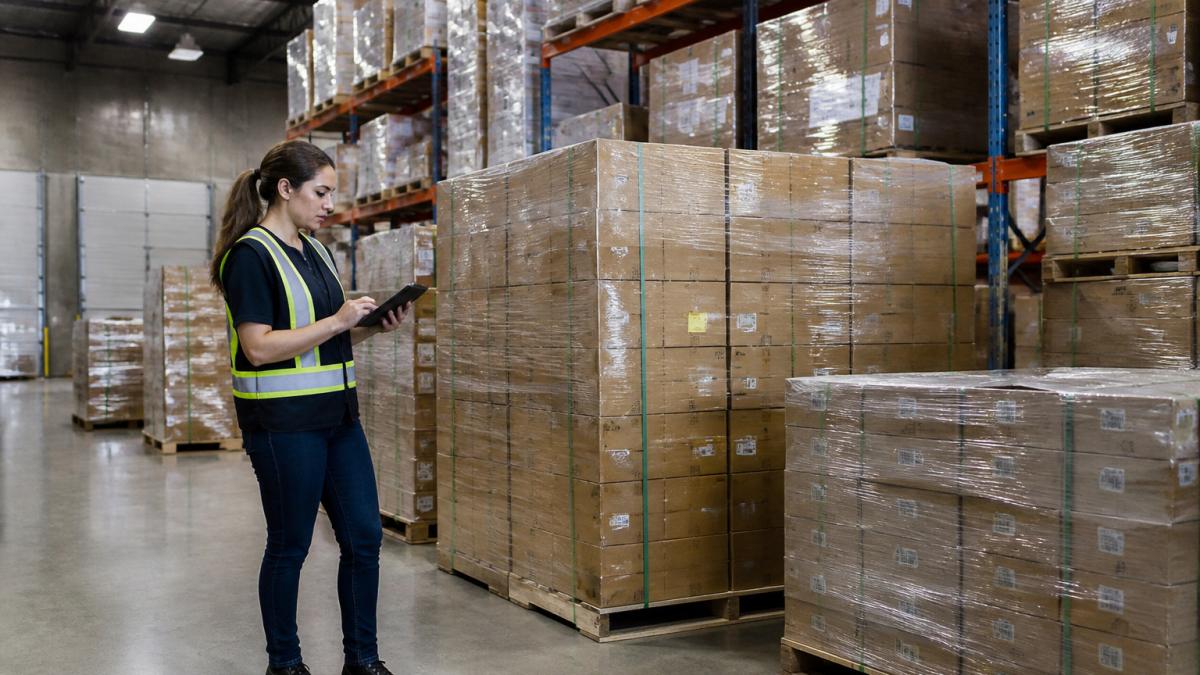
- Picking: Items are located and pulled, ideally in batches sorted by zone to reduce walking time.
- Packing and verification: Items are checked against the order, then packed with the correct materials.
- Shipping: Carrier labels are generated, and parcels are staged for pickup at a fixed cutoff.
- Tracking and returns: Tracking details reach the customer, and returns are received, inspected and restocked or written off.
A useful test is whether each step can be measured. Order accuracy, pick time per order and on-time dispatch rate are simple KPIs that reveal bottlenecks well before customers complain.
Inventory Management for E-Commerce Across Channels
Inventory management becomes harder once you sell on more than one channel. Stock that appears available on your website may already be committed to a marketplace order, and a single error can cause overselling. Flexible options such as short- and long-term pallet storage can help hold stock across channels. The fix is not more counting, it is a system that forecasts, allocates, and flags problems before they reach a customer.
One source of truth, updated in near real time
Every channel, your storefront, marketplaces, retail partners, should read from and write to a single inventory record. When a marketplace order commits stock, your website should reflect it within minutes, not overnight. The practical test: place a test order on each channel and confirm the available count drops everywhere within your sync window. If it does not, overselling is a matter of time.
Demand forecasting that is actually usable
You do not need a data science team to forecast. A workable approach uses three inputs:
- Your own sales history, ideally 12 months or more, so seasonal patterns are visible.
- A demand signal for known events, promotions, launches, and peak seasons, layered on top of the baseline.
- Lead time from supplier to warehouse, which determines how far ahead you must commit.
Forecast at the SKU level for your top sellers and at the category level for the long tail. Forecasting every slow-moving SKU individually produces noise, not insight.
Safety stock and stockout logic
Safety stock exists to absorb variability in demand and lead time. A simple, defensible rule is to set safety stock as a buffer proportional to how much both vary: SKUs with stable demand and reliable suppliers need less; SKUs with volatile demand or long, uncertain lead times need more. Review the buffer quarterly, a safety stock set once and never revisited is usually either too high (tying up cash) or too low (causing stockouts).
Allocating stock across channels
An even split across channels is almost always wrong. Allocate according to each channel's actual sell-through and margin, and reserve a buffer for your highest-margin channel. Two rules make this manageable:
- Priority allocation. Decide in advance which channel gets stock first when supply is short, and document it so the decision is not made in a panic.
- Channel-specific buffers. Give channels with longer fulfillment windows or higher return rates a larger buffer than fast-turn channels.
The KPIs that tell you inventory is working
Track a small dashboard rather than a wall of metrics:
- Stockout rate on top-selling SKUs
- Overselling incidents per month
- Inventory turnover by category
The article's key inventory KPIs, which help show whether stock management is working:
| KPI | What it reveals | Why it matters |
|---|---|---|
| Stockout rate | How often top-selling SKUs run out | Lost sales on best sellers |
| Overselling incidents | Stock promised beyond what exists | Cancelled orders and customer trust |
| Inventory turnover | How quickly stock sells by category | Cash tied up in slow stock |
| Days of cover | Stock on hand versus supplier lead time | Whether reorders arrive in time |
| Return rate by SKU | Problem listings or quality issues | Surfaces defects before reviews do |
Scaling Logistics Next Steps: Requesting a Rate Quote from GTC Logistics
Scaling logistics is a sequence of decisions: when to separate storage from packing, when a 3PL or hybrid model makes sense, and how to keep inventory visible as channels multiply. You can keep exploring related guidance on the logistics and supply chain insights hub before reaching out.
GTC Logistics operates a 30,000 square foot facility in Saint-Laurent, QC, with CBSA bonded warehousing, cross-docking available until 9:00 PM, and inventory visibility through the Inventory Cloud Oracle NetSuite platform. Pricing depends on quantity, dates and delivery, so the most accurate starting point is a quote based on your own numbers. Request a rate quote from GTC Logistics to see what a tailored setup would look like for your business.
Frequently Asked Questions
How do you scale logistics for an e-commerce business?
Scale logistics in stages rather than all at once. Start by measuring cost per order, order accuracy and on-time delivery so you know where operations break down. Then match your fulfillment model to your current order volume: in-house packing may work at low volume, while a third-party logistics provider or a hybrid setup often makes more sense as orders climb and peak seasons arrive. Tie each change to a measurable KPI so you can confirm it is working before the next expansion.
What are the main components of an e-commerce logistics strategy?
A complete e-commerce logistics strategy covers warehousing and storage, order fulfillment, inventory management, carrier selection, last-mile delivery and returns handling. Each component affects cost and customer experience. Shipping speed and delivery transparency influence customer retention, while inventory visibility determines whether you can avoid stockouts across channels. Review these components together, because a change in one, such as adding a new sales channel, usually affects the others.
When should an e-commerce business outsource fulfillment?
Consider outsourcing when order volume becomes hard to handle in-house, when packing and shipping take time away from sales and product work, or when you need storage space or faster delivery than your current setup allows. Pricing with a fulfillment provider depends on quantity, dates and delivery requirements, so request a quote from GTC Logistics for current rates. Compare the total cost of an in-house team, space and equipment against the provider's per-order and storage charges.
How can e-commerce businesses improve order fulfillment speed and accuracy?
Speed and accuracy improve when order data flows automatically from your storefront to your warehouse system, reducing manual entry errors. Standardize packing procedures, use barcode scanning to confirm each item, and track order accuracy as a KPI. Shipping consolidation and clear cut-off times for same-day dispatch also shorten delivery windows. Regular cycle counts keep inventory records aligned with what is physically on the shelf.
What logistics technology helps an e-commerce business scale?
Warehouse management systems, inventory platforms and integrated order management tools help a growing business track stock, route orders and report on performance in real time. The right system connects your sales channels to your fulfillment operation so that inventory counts update as orders are placed. GTC Logistics operates on the Oracle NetSuite Inventory Cloud platform, which provides real-time inventory visibility. Confirm how any system integrates with your current storefront before committing.


